
JARVIS &
System Brain.
Towards accountable machine decision-making and progressively autonomous departments.
The research question
How can role-specialised AI systems assume routine decision work while preserving evidence, controllability and measurable reliability?
We propose JARVIS as an exclusively English-speaking interface to System Brain, a coordination layer for role-specific software agents. Each proposed AI employee combines a role contract, curated skills, scoped tools, memory and an evaluation record. “Cells” name modular software responsibilities; “feel” names a measurable appraisal of urgency, uncertainty and consequences. The existing Souq implementation provides a concrete engineering antecedent. Source inspection identifies fifteen initial cell slots, knowledge imports, persistent memory, bounded delegation and a recommendation council. Seven isolated prototype tests pass across thirty-two assertions. These tests establish selected application behaviours, rather than the quality of model-generated decisions. Four controlled experiments investigate the decision-control substrate. Across 12,000 synthetic tasks, the complete policy gate executes 1,888 proposals (15.7%) with zero violations of the encoded policy, while proposal correctness among those executions is 85.1%. Thus policy compliance and semantic accuracy are distinct. Provenance filtering improves retrieval validity on explicitly labelled synthetic records, and correlated-voter simulations show why adding agents does not guarantee independent expertise. The programme aims to replace selected human-operated routine workflows progressively, using measured task-level acceptance. Equivalence to a panel of one hundred specialists and end-to-end millisecond decision-making remain hypotheses requiring separate expert and live-model studies. This report supplies the definitions, architecture, evidence and experimental protocol needed to investigate them.
Inside the prototype
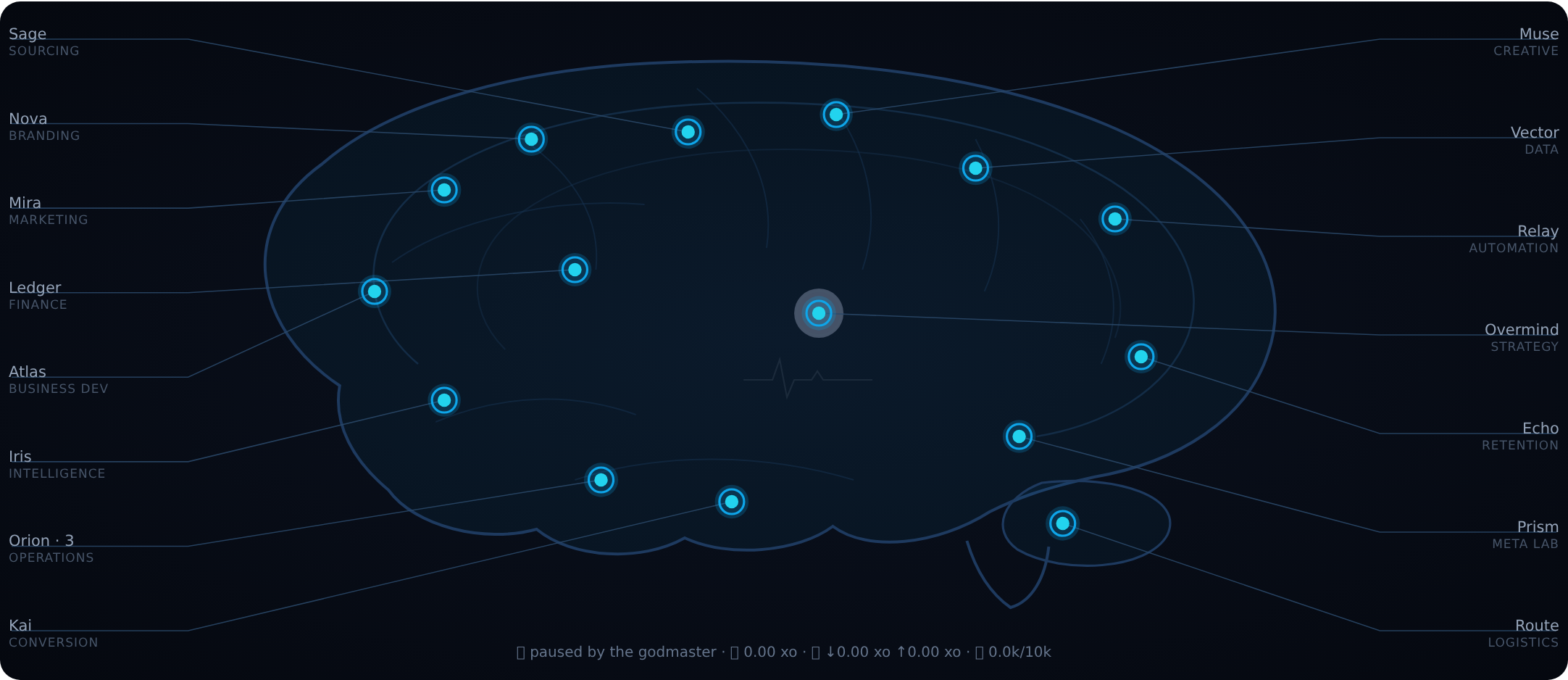
What the edition contains
- Architecture and a staged approach to routine departmental automation.
- Prototype inspection and seven isolated application tests.
- Four controlled synthetic experiments and reproducible supporting files.
- Four authentic interface screenshots with labelled sample data.
- A blank three-page evaluation questionnaire.
- An author statement and authorised typed signature.
How to interpret the evidence
This edition reports software tests and controlled synthetic experiments. Live-model and specialist-comparison measurements are assigned to the next experimental series. The questionnaire supports that continuing research programme.
Suggested citation
Zahran, M. O. (2026). JARVIS & System Brain: Towards accountable machine decision-making and progressively autonomous departments. ZEISMO Research & Lab. Technical report ZEISMO-LAB-TR-2026-001, version 1.3. Preprint.
Research conversation
Discuss the methods, reproducibility and proposed questionnaire in the moderated research forum.
Visit the research forum ↗